

Last night a DJ saved my life: How Austin’s first “record bar” creates hold-your-breath moments
How do you recreate a Japanese-style kissa in Texas? Josh LaRue on sonics, selecting, and the eternal power of a communal listening experience.

Touring Japan is a head-snapping experience.
I’m fortunate to have done it twice, one time a no-budget sleep-on-the-bathroom-floor deal (I’m speaking literally here), the other a fancy hotel-staying, bullet train-riding blowout (again, literally: the tour promoter declared bankruptcy shortly after our last Unagi-ya expedition).
On these visits, I noticed how concepts I more or less took for granted could be subtly reprocessed. Take the kissa, a coffee shop or bar reconfigured as a “temple of listening,” a place to sit quietly and zone out to prerecorded music. According to ace Portland music writer Aaron Gilbreath, the very first jazu kissa opened in 1929—I’ve seen its name rendered as either “Black Bird” or “Blackbird.” Besides providing an alternative to live concerts, they allowed ordinary music fans to experience imported recordings they couldn’t otherwise have afforded, played back on high-quality sound systems that were similarly out of reach.
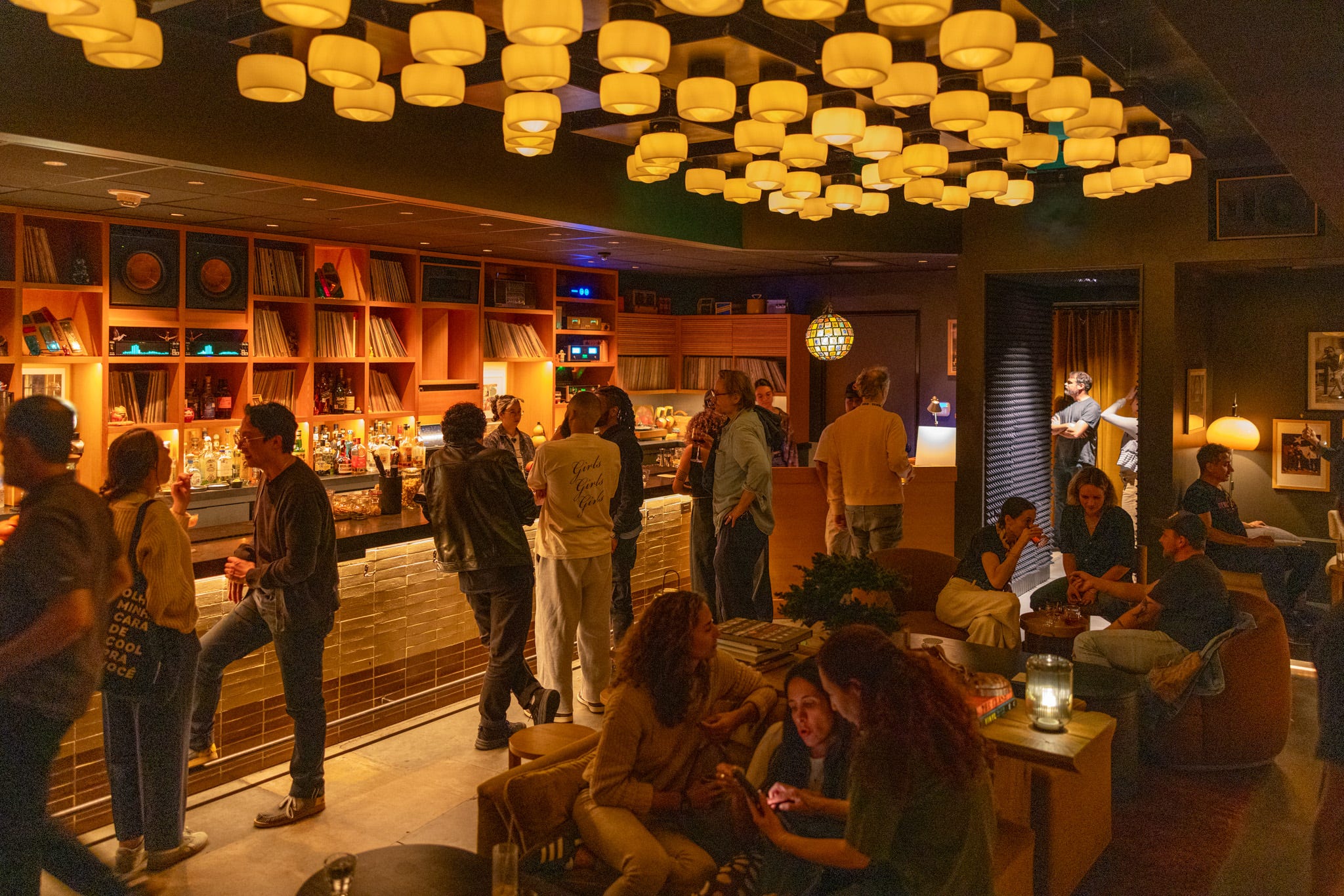
Today kissa are a global phenomenon, found everywhere from Barcelona to Melbourne, London to Bielefeld. And in Austin, where Josh LaRue, owner of Breakaway Records (and a member of Jack O’ Fire, Rain Like the Sound of Trains, The Sorts and many other bands) is a partner in the Equipment Room, a very Texan version of a classic kissa. Here’s what he has to say about the endeavor.
Seth: “There’s a fine line between how music, environment, and equipment influence the emotional experience of music.
“What’s the line between performance and playback? This idea of a public space where the point is listening to music (but it’s not a performance) is like this weird gray zone, no?
Josh: I mean, even before Equipment Room [opened], I’ve thought about exactly this. I love music, obviously; I played in bands and all that stuff, but even from an early age I was fascinated by the recording. And I still, to this day, even though it’s what I do for a living, don’t totally understand how music comes out of the speaker…I mean, on some levels I understand, but it still seems like fucking magic to me somehow. And it’s, you know, really old technology, if you go back to the 78 shellac and the cylinders and all that kind of stuff.
Seth: What are the challenges of combining focused listening with other activities—serving food and beverages, for instance? It seems almost intractable.
Josh: So, it’s interesting. With Equipment Room, the journey sort of started like jazz kissas. I was lucky enough to get to go to Japan a number of times, and I was like: Man, this is really cool! It’s a bar, ultimately—in Japan, you know, it’s a pretty big drinking culture. People went there and they got a big glass of whiskey or shochu or whatever. But people were really quiet, generally. And I’m not an expert on jazz kissas in general, so I don’t know if they’re all like this, but my impression was that people were typically more reserved, or maybe quieter until they get drunk!
There was somebody, almost always a man, making drinks and selecting the records, and people were mostly just sometimes sitting alone or in very small groups, and mostly not even chit-chatting, mostly just listening. I feel like there was even one where they had an elaborate menu and you could request an album to be played—although I think you had to, ultimately, wait a very long time to actually hear your album. And maybe that’s a good strategy on the business’s part, drinking for a long time!
But we always were unsure as to what the behavior would be like in America, in Texas and in Austin. We hoped that it would be similar because we invested a lot of time and money and research into making the room sound as good as possible, but we also didn’t want [the music] to be loud. And we weren’t really sure how it was going to go. And at first we tried to be a little bit more enforcing about people being quiet, which is a really tough situation, a tough thing to navigate.
Seth: How do you manage that? Like me, you’re old enough to remember the days of smoking and non-smoking sections in restaurants and how silly that was, because if you’re in an enclosed space near cigarette smoke, it’s all the smoking section! You didn’t try to institute a “quiet zone” or “loud zone”?
Josh: So it took us a while to basically figure out what the happy medium was. Say it’s 11:30pm on a Friday and you’re on your third drink and you’re 25 and you’re having fun. And I don’t begrudge any of these people! I mean, these are the customers. In most clubs or bars if there’s a DJ, they just keep turning [the music] up to drown out the conversation, and then the conversation gets louder, and then you haven’t really solved the problem.
I think there were people, especially at the beginning, who knew what a jazz kissa was supposed to be, and expected it to be like almost silent. So the hardest thing was not only navigating the different reactions and ways of being, but also navigating our own expectations and trying to just roll with it and ultimately find a happy medium.
It took six months to a year, honestly, before it kind of found its way. I would say on most days, from 5pm to 8pm it’s—it’s not like it’s silent in there, it’s still a bar, but—it’s quieter. And there’s some spots, especially right at the bar, where you’re really close to the speakers.
Again, it’s not like it’s loud in there. Nobody’s going to go deaf or anything. But you can make a place for yourself where, if you want to focus on the music more, you can do that. And if you want to socialize more, there’s couches and tables and stuff like that, where people can sit. It kind of has naturally worked itself out, although certainly once a week somebody gets mad that it’s too loud. And certainly once a week somebody gets mad because they’ve been asked politely to lower their voice, you know.
And then we have headphone amps. It’s the same signal, so you’re still just hearing whatever album is playing at that moment. But there are currently six headphone amps, and we’re in the process of installing four more. So if you’re there by yourself…I know listening on headphones is a totally different experience than hearing it out loud over speakers.
Seth: You’re also touching on the fact that people are omnivores now more than ever, and that shuffling is kind of the norm. How do you manage playlists and genres?
Josh: It sounds kind of like corny, or pretentious or whatever, but we call the people “selectors.” I mean, I love Jamaican music and all that. But it kind of takes the DJ thing out of it and takes people feeling like they can request things out of it.
I mean, I’ve DJ’d forever, and I love the song-to-song style and connecting the dots and having three minutes to figure out your next move and all that. But this is sort of a, you know, “Slow Food” version of that, where it’s playing an album side, 15 to 22 minutes. And you know, albums have peaks and valleys and sometimes kind of a shitty song. And if the vibe is working, they’ll flip it over and play the whole album.
There’s about 1300 or 1400 albums there right now, all kinds of genres. And so I put up guardrails, but it’s really big guardrails. There’s reasons for everything being there, but there’s a lot of records that I don’t personally know that well, or I personally don’t like that much, you know. Through the record store, I probably have kept my taste a little more current than the average 56 year old, but I still don’t know what’s going on; we built this big record collection with a lot of people’s input.
Seth: Does the audience follow selectors? Do they come knowing that a genre is going to be represented, or it’s going to skew one way, or is that kind of randomized?
Josh: It’s pretty randomized. We kind of ultimately decided it’s better to keep the genres always moving than to get really deep into, you know, African records or jazz records or something, because it just gives a broader and maybe more representative experience of what the place is and what the library is.
So if you’re there for 90 minutes or two hours, you might hear Willie Nelson, and you might hear A Tribe Called Quest, and you might hear Jackie McLean. The people that work there are pretty good at figuring out how to make it all work. You know how to connect the dots. It’s a good analogy for DJing or selecting: How do you get to Townes Van Zandt, but right now I’m playing Chaka Khan? How do I make that not super-abrupt? Do I play a Muscle Shoals soul record or something?
Seth: “Without going insane, tell me a bit about the gear.”
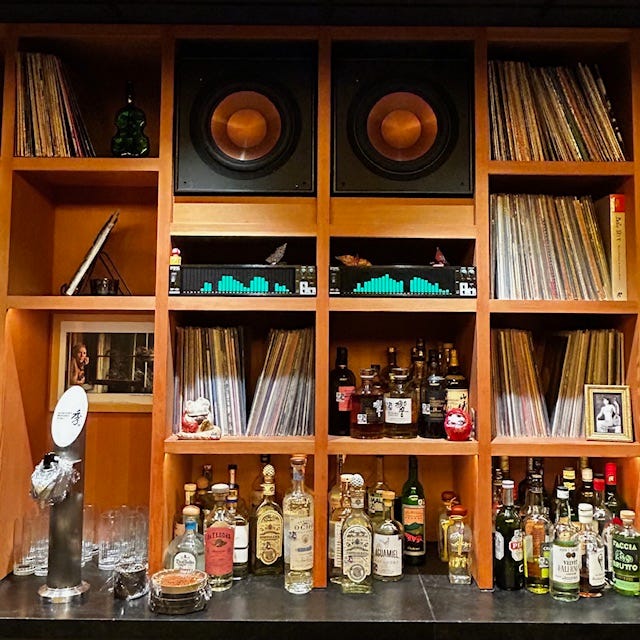
Josh: So the speakers are all Klipsch speakers, the big ones in the back bar are Klipsch La Scalas. Those are the main speakers. And then there’s two subs built into the wall, which is funny because, you know, those La Scalas are really, really huge speakers, but they don’t have a ton of low end. The thing that they’re really the most magic at is midrange and just really accurate reproduction. But people, including myself, especially over the last 20 to 30 years, have really gotten used to there being a lot of low end in music. So it’s nice to have those subs there, just to be able to do that for the records that have that information in them.
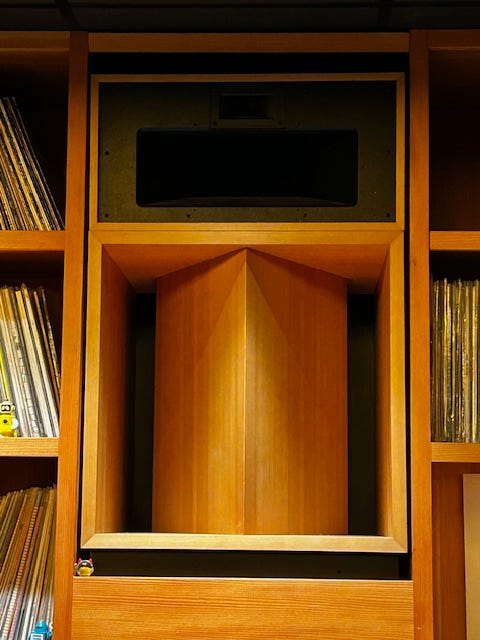
And then there’s a separate small room. It’s not really private; it kind of almost has a little doorway that’s always open. That room has its own dedicated pair of Klipsch Heresy speakers and another small sub that’s kind of like buried in a corner. So when you’re in that room, you might hear a little spillover of the La Scalas from the main room, but really its own kind of room with its own setup and it sounds quite good in there, but it’s quite different because you’re much closer to the speakers. It’s cool to be able to go back and forth and hear two totally different perspectives.
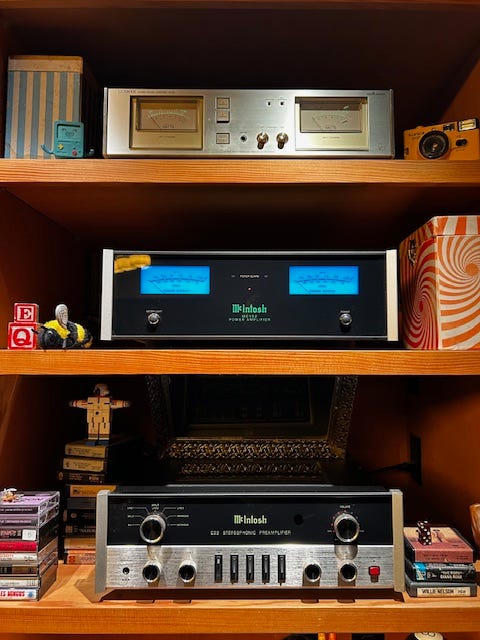
And then there’s a Macintosh amp. There’s a Luxman, which is a Japanese company; the Macintosh powers the La Scalas and the Luxman powers the Heresies. And then there’s a Macintosh preamp, which is kind of the brain of everything. And then there’s classic, you know, Technics 1200s turntables.
There’s a mixer…I’m drawing a blank. Condesa! Condesa is the name of the company, they’re from Australia. They’re really nice hand-wired all-analog rotary mixers. And again, people aren’t really doing much like mixing in a traditional DJ sense, there’s hardly any crossfading or any of that type of thing going on. People are basically just using it for volume control.
And that’s pretty much it. There’s also a nice Nakamichi tape deck there, which we sometimes use to either play tapes or record to just for fun. There’s a really nice Pioneer 8-track player, which…8-tracks are goofy and whatever. But it was just more we had it, and it looked good, and sure it’s hooked up.
And 8-tracks and cassettes both can sound amazing, you know. But we rarely are using it for playback. And then I just recently got a restored Sansui reel-to-reel that we’re going to install this spring, which will probably mostly be for recording, like if we have a special event or a guest DJ or selector come in. Or who knows? We haven’t exactly decided how we’ll use it, but it looks cool and it will sound good.
The Aesthetics of Sound
Seth: You’re kind of touching on the aesthetics of this pursuit, and it makes me think of an experience I had in Japan, touring the Studio Ghibli Museum. It was really lovely and kind of emotional. In the first room you enter there’s a music loop playing, and right in the middle of the room, under plexiglass, is a floor-to-ceiling equipment rack, and in it is an old Altec rig, a preamp and mono blocks with Coke-bottle vacuum tubes. And with the aesthetics of the films and the aesthetics of this massive glowing device playing the music back, it’s an oddly profound effect. It sounds like you’re sort of catching on to that to some extent.
Josh: Yeah I mean for sure, the aesthetics are a big part of it. The main thing is, it’s got to sound good. But people respond to visuals, and so all the gear is prominently displayed, and we really encourage discussion about it. All the [employees] are pretty well versed, they know about the gear and can talk about it.
And of course you get, like, the 60-year old guy who wants to flex about his stereo and that kind of stuff. And they may know much more than the person playing the records! That’s part of the fun, too. I just wanted the type of personality that was comfortable having a discussion rather than…you know, I spent years DJing [and] refusing to talk! “No requests!” This is a different thing for sure.
Seth: So you’ve been open three years. What’s a standout moment?
Josh: We started this series, we’ve been doing it for a year and a half now, where on Sundays we feature a specific record, and it’s a ticketed event. We really do ask people to put their cell phones away and just be quiet. And you know, most records are 40 minutes long. Like, it’s not a long time. It is amazing how hard it is for people to let go of their phones, myself included, but it’s really magical, especially when a whole room full of people does it, just sits and closes their eyes. If you really pause all that extraneous bullshit, and whether it’s an album you’re super-familiar with, or something maybe you’ve only heard a few times just to take 40 minutes and really pay attention to music, especially as a communal thing, it is really magic.
The very first one we did was D’Angelo’s Voodoo, which is a record I love a lot, it’s my stereo tester. And I think that one in particular, it was the first time we’d ever done this. And so we didn’t…we didn’t really know how to navigate it, and I think the audience didn’t really either.
But when the record was over, the room literally stayed silent for maybe two minutes, which doesn’t sound that long, but…for 40 people to be silent together for 90 seconds, or two minutes or whatever was, like, chilling. It was incredible. Nobody wanted to break the silence. I mean, nobody even wanted to put a glass down. It was like holding your breath. And that has happened multiple times. To have people have that feeling and reaction is really incredible.
Love this article! And, hi Josh!!!
Thanks Seth. I’ma have to check this place out!